
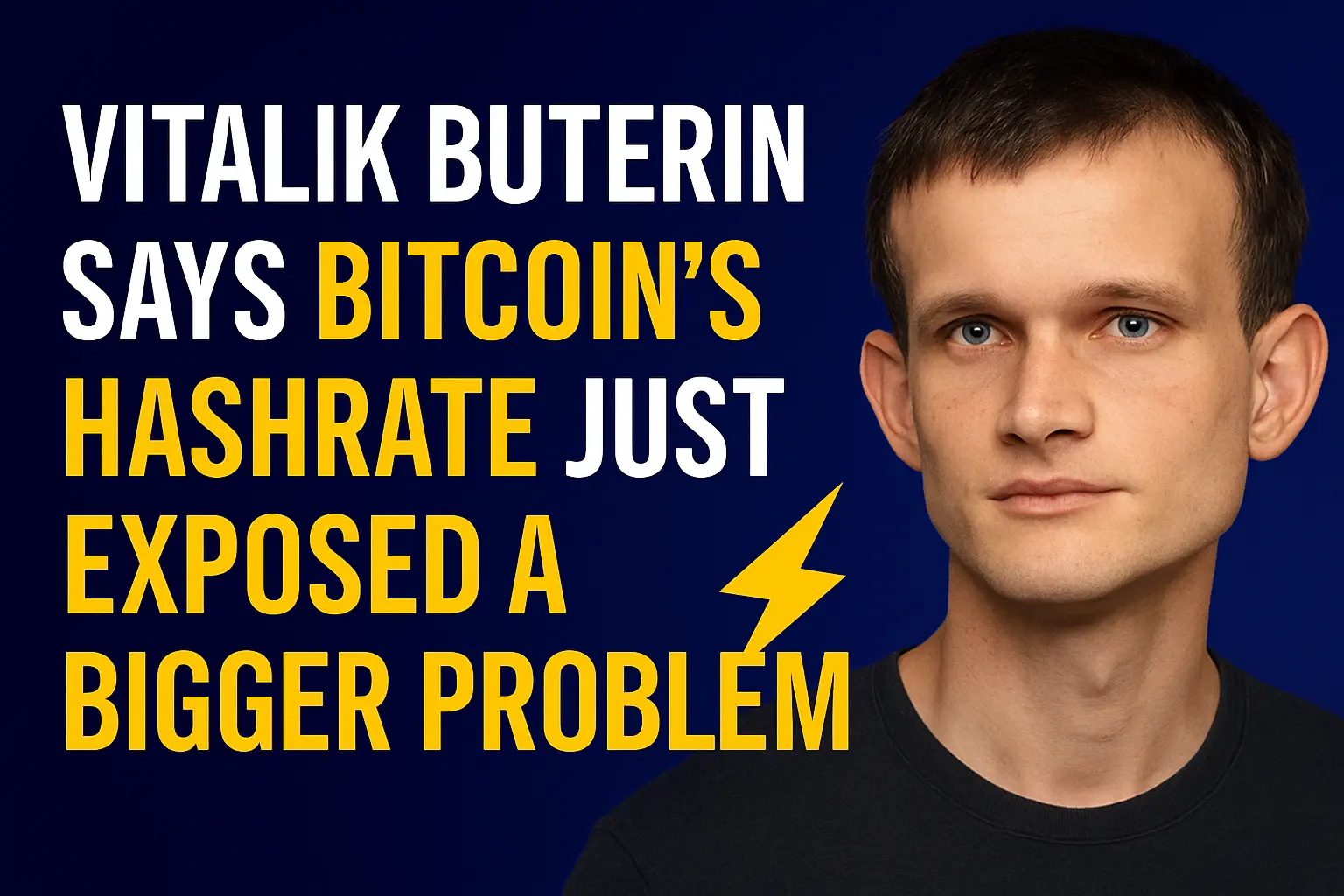
Bitcoin recently achieved a massive milestone, with its total lifetime proof-of-work output surpassing an estimated 296296 hashes. While the community celebrates this as a testament to the network's immense security, Ethereum co-founder Vitalik Buterin views it through a different lens: not just as a victory, but as a warning signal for the future of blockchain security.
The Core Issue
As Bitcoin pushes the boundaries of hashrate into uncharted territory, Buterin argues that the industry must urgently upgrade its cryptographic standards to prevent falling behind the curve of global computational power.
🔹 Key Insights
- The 96-Bit Barrier: Bitcoin's cumulative PoW is now roughly equivalent to 96-bit brute-force security.
- Raising the Bar: Buterin advocates for a new industry-wide standard of 128-bit security minimum.
- Modern Solutions: He points to upgrades like BLS12-381 and the "Lean Ethereum" roadmap as examples of necessary evolution.
- The Threat: As global hashpower rises, legacy cryptographic systems that once seemed unbreakable may soon fall short of modern requirements.
🔍 Deep Dive: Why It Matters
Bitcoin's cumulative Proof-of-Work acts as a massive "energy wall"—the cost required to rewrite the blockchain's history. Hitting the 296296 hash mark demonstrates just how formidable this wall has become.
However, there is a catch. This exponential growth in raw computing power highlights a critical vulnerability: if blockchain networks do not evolve their underlying cryptographic foundations, the very hardware advancements driving this growth could eventually be used to break older security models.
🧠 The Bottom Line
This isn't a debate about Bitcoin vs. Ethereum—it is about the long-term survival of decentralized finance.
As hardware capabilities accelerate, the crypto industry cannot afford to stagn
ate. Adopting 128-bit secure systems must become the default. If cryptocurrency aims to serve as the global settlement layer for the next century, its security assumptions must scale even faster than the blockchains themselves.
