
Key Takeaways
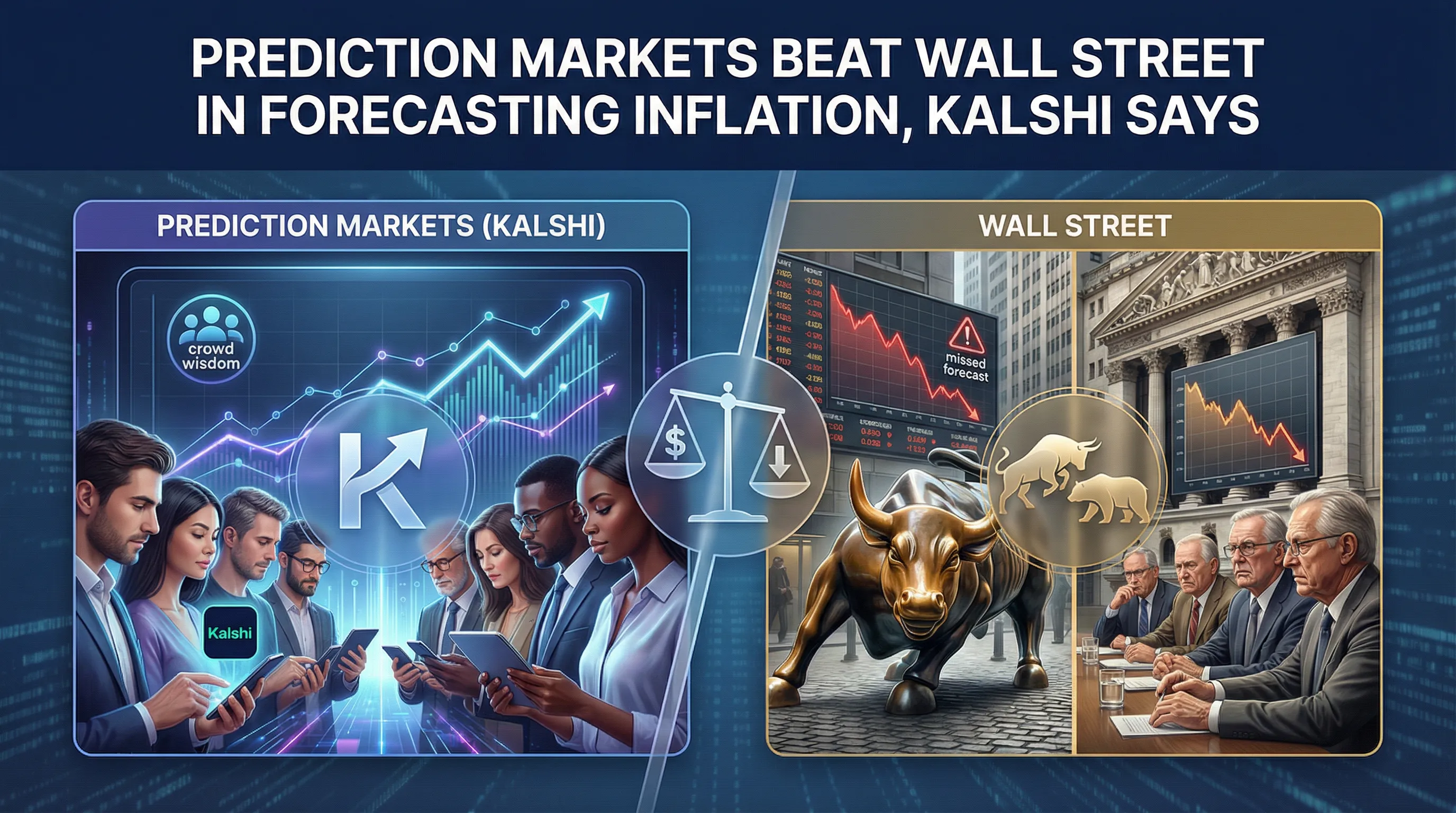
- Superior Accuracy: Prediction market forecasts for CPI inflation showed a 40% lower average error than Wall Street consensus over a 25-month period.
- Volatility Advantage: The performance gap widened significantly during economic shocks, with prediction markets outperforming by up to 67%.
- Early Warning Signal: A significant divergence between prediction market and consensus forecasts one week before a CPI release indicated an 80% chance of a surprise outcome.
- Core Mechanism: Success is attributed to real-time "wisdom of the crowd" aggregation, diverse data inputs, and direct financial incentives for accuracy.
Prediction Markets vs. Wall Street: A Forecasting Showdown
A groundbreaking study from prediction market platform Kalshi demonstrates that crowd-sourced market forecasts consistently outperform traditional Wall Street economists in predicting inflation, especially during periods of economic uncertainty. The research, titled "Crisis Alpha: When Do Prediction Markets Outperform Expert Consensus?", provides compelling evidence for the power of decentralized information aggregation.
Quantifying the Forecasting Edge
The analysis compared inflation forecasts on Kalshi's platform with Wall Street consensus estimates from February 2023 to mid-2025. The results were striking:
- Market-based forecasts for year-over-year Consumer Price Index (CPI) changes exhibited a 40% lower average error.
- During periods where the actual inflation figure deviated sharply from expectations, the prediction market's accuracy advantage surged to as high as 67%.
This suggests that when the economic forecasting environment becomes most challenging, the unique strengths of prediction markets become most valuable.
The Mechanism Behind the Superiority
Why do these platforms beat institutional experts? The study points to several key factors:
- Diverse Information Aggregation: Unlike traditional models that often rely on similar datasets, prediction markets like Kalshi and Polymarket synthesize views from a broad set of traders using varied inputs, from sector-specific trends to alternative data.
- Powerful Financial Incentives: Traders have direct monetary stakes, rewarding accurate predictions and penalizing poor ones. This contrasts with institutional forecasters who may face reputational constraints against bold calls.
- Real-Time Updates: Market prices update continuously, avoiding the lag inherent in consensus estimates, which are typically fixed days before official data releases.
"When the forecasting environment becomes most challenging, the information aggregation advantage of markets becomes most valuable," the study notes.
Implications for Institutional Decision-Making
The report positions prediction markets not as a wholesale replacement for traditional methods, but as a powerful complementary tool. Market-based signals offer particular value during periods of structural uncertainty and can enhance broader risk and policy planning frameworks.
The sector is gaining significant traction. Kalshi recently integrated with the crypto wallet Phantom and raised $1 billion at an $11 billion valuation. Competitor Polymarket is also reportedly in talks for funding at a valuation as high as $15 billion.
While challenges like herd mentality and low liquidity exist, the data is persuasive. Separate research has shown platforms like Polymarket achieving 90-94% accuracy in event prediction. For financial institutions and policymakers, incorporating these decentralized forecasting signals may no longer be optional—it may be essential for navigating an increasingly volatile economic landscape.
