Key Takeaways
- Potential Downside: A Fed pause on rate cuts in Q1 2026, coupled with persistent inflation, could pressure Bitcoin (BTC) towards $70,000 and Ethereum (ETH) towards $2,400.
- Liquidity is Key: The Fed's new "stealth" liquidity measures may provide crucial support for crypto asset prices, even in a higher-rate environment.
- Market Paradox: Despite three 2025 rate cuts, crypto markets sold off, highlighting that forward guidance and economic data often matter more than the cuts themselves.
- Bullish Catalyst: Continued institutional investment via ETFs and sustained liquidity injections could propel Bitcoin to a range of $92,000-$98,000.
The Fed's 2025 Moves and Crypto's Counterintuitive Reaction
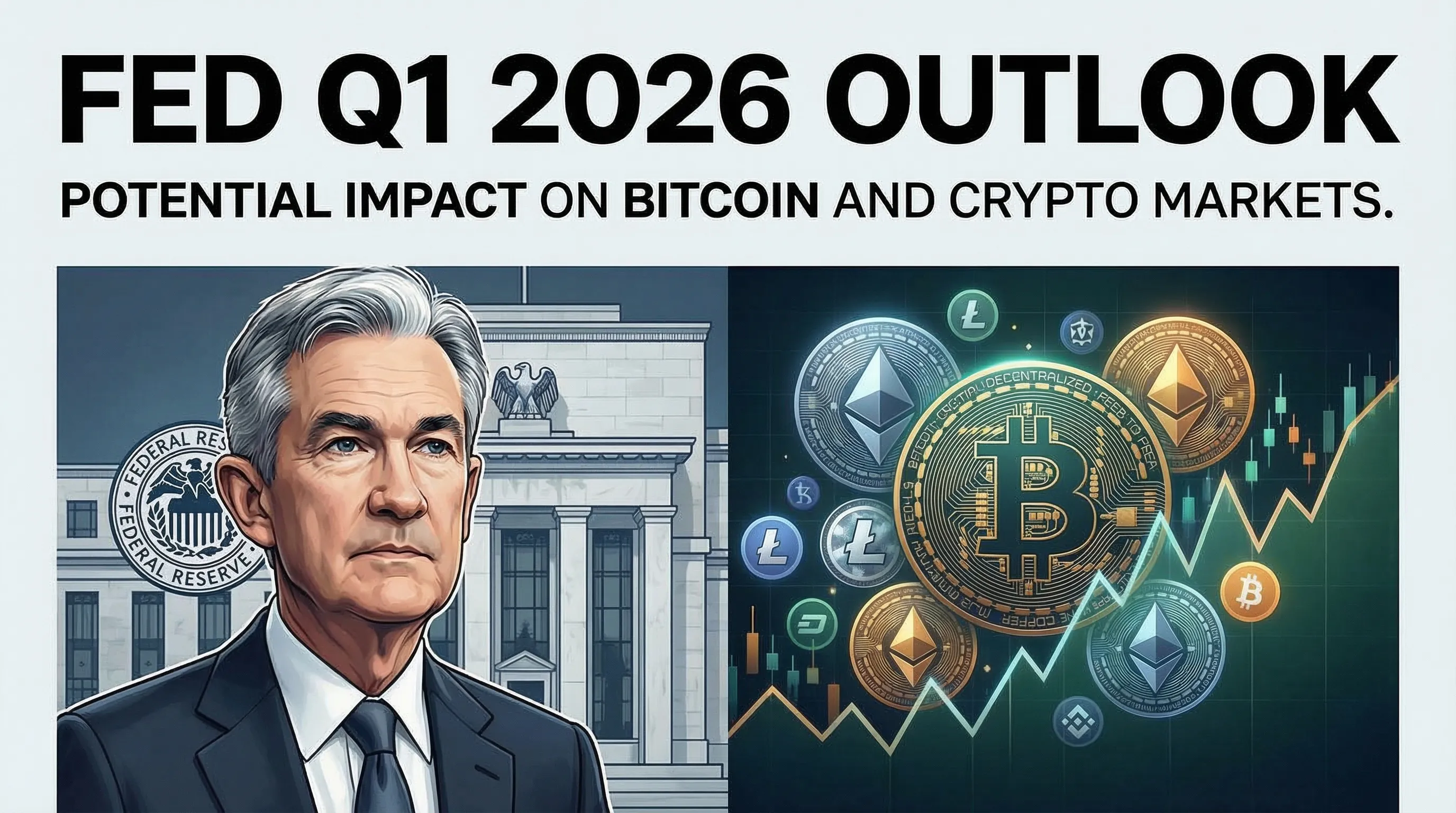
The US Federal Reserve executed three interest rate cuts in 2025, primarily in the final quarter, responding to rising unemployment and clearer signs of cooling inflation. Contrary to typical market logic, this dovish pivot did not ignite a crypto rally. Instead, Bitcoin, Ethereum, and major altcoins faced significant selling pressure, erasing over $1.45 trillion from the total cryptocurrency market capitalization since its October peak.
This divergence sets the stage for a critical question: How will Federal Reserve policy shape the digital asset landscape into the first quarter of 2026?
Q1 2026 Outlook: Between a Pause and Persistent Inflation
Despite the 2025 cuts, Fed officials have maintained a cautious, data-dependent stance. New York Fed President John Williams encapsulated this sentiment, stating in December: "I don’t personally have a sense of urgency to need to act further on monetary policy right now, because I think the cuts we’ve made have positioned us really well."
This suggests a potential pause in the easing cycle. Jeff Mei, COO of crypto exchange BTSE, warns that if the Fed holds rates steady throughout Q1 2026 while inflationary pressures linger, it could create headwinds: "BTC could drop to $70,000, and ETH could dip to as low as $2,400." Economic data uncertainty, exacerbated by a historic government shutdown, further complicates the inflation picture and market expectations.
The "Stealth QE" Wildcard: A Liquidity Lifeline
However, the interest rate story is only one part of the monetary policy equation. In early December, the Fed formally ended its quantitative tightening program. More significantly, it initiated Reserve Management Purchases (RMPs)—roughly $40 billion in short-term Treasury bill buys—to stabilize the banking system.
Many analysts view this as a form of "stealth quantitative easing (QE)." While its scale is far smaller than the $800 billion monthly balance sheet expansion seen during the 2020-2021 QE boom (which coincided with crypto's massive bull run), it still represents a quiet injection of liquidity into the financial system.
Two Scenarios for Crypto in Early 2026
The interplay between Fed rates and Fed liquidity creates two primary pathways for Bitcoin and Ethereum:
- Bearish Scenario (Hawkish Pause): The Fed pauses cuts amid sticky inflation data, emphasizing its commitment to price stability. This could trigger risk-off sentiment, testing the lower support levels for BTC and ETH.
- Bullish Scenario (Liquidity Support): Even with a rate pause, the continuation of RMPs or similar liquidity operations provides a market floor. This liquidity, combined with robust institutional demand, could fuel upward momentum. As Jeff Mei notes, "This means Bitcoin could climb to $92,000-$98,000, supported by ongoing ETF inflows surpassing $50 billion and institutional accumulation."
Disclaimer: This article is for informational purposes only and does not constitute investment advice. All investment and trading decisions involve risk. Readers should conduct their own independent research. While we aim for accuracy, we do not guarantee the completeness or reliability of any information herein, including forward-looking statements subject to risks and uncertainties.